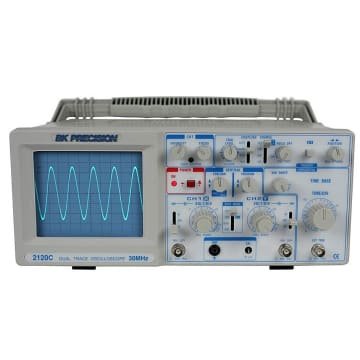

Oscilloscopes are essential test instruments used for observing and analysing electrical signals over time. Analogue oscilloscopes use CRT (Cathode Ray Tube) technology for real-time waveform display, while digital oscilloscopes offer modern features such as signal storage, advanced triggering, and digital signal processing.
Analogue Oscilloscope Features:
- Real-Time Display: Instantaneous waveform rendering with minimal signal delay
- CRT Display: Sharp, high-contrast waveforms on phosphor screen
- Bandwidth Options: Typically 10 MHz to 100 MHz
- Vertical Channels: Usually 2-channel input with voltage range from mV to hundreds of volts
- Simple Controls: Manual knobs for time/div, volts/div, triggering, and position
⚙️ Applications: Education, audio, analogue circuit diagnostics, RF signals (limited)
- Digital Oscilloscope Features:
Digital Signal Processing (DSP): Stores waveforms for analysis, zoom, and comparison - Bandwidth: Ranges from 20 MHz to 1 GHz+
- Display: TFT/LCD screen with colour-coded waveforms
- Sampling Rate: Typically 1–5 GS/s (Giga samples per second)
- Storage & USB Interface: Save waveforms to USB or internal memory
- Advanced Triggering: Edge, pulse width, video, pattern, and serial bus decoding
- Connectivity: USB, LAN, RS-232, or Wi-Fi (on advanced models)
- Applications: Embedded systems, automotive diagnostics, high-speed digital signals, education, power electronics